
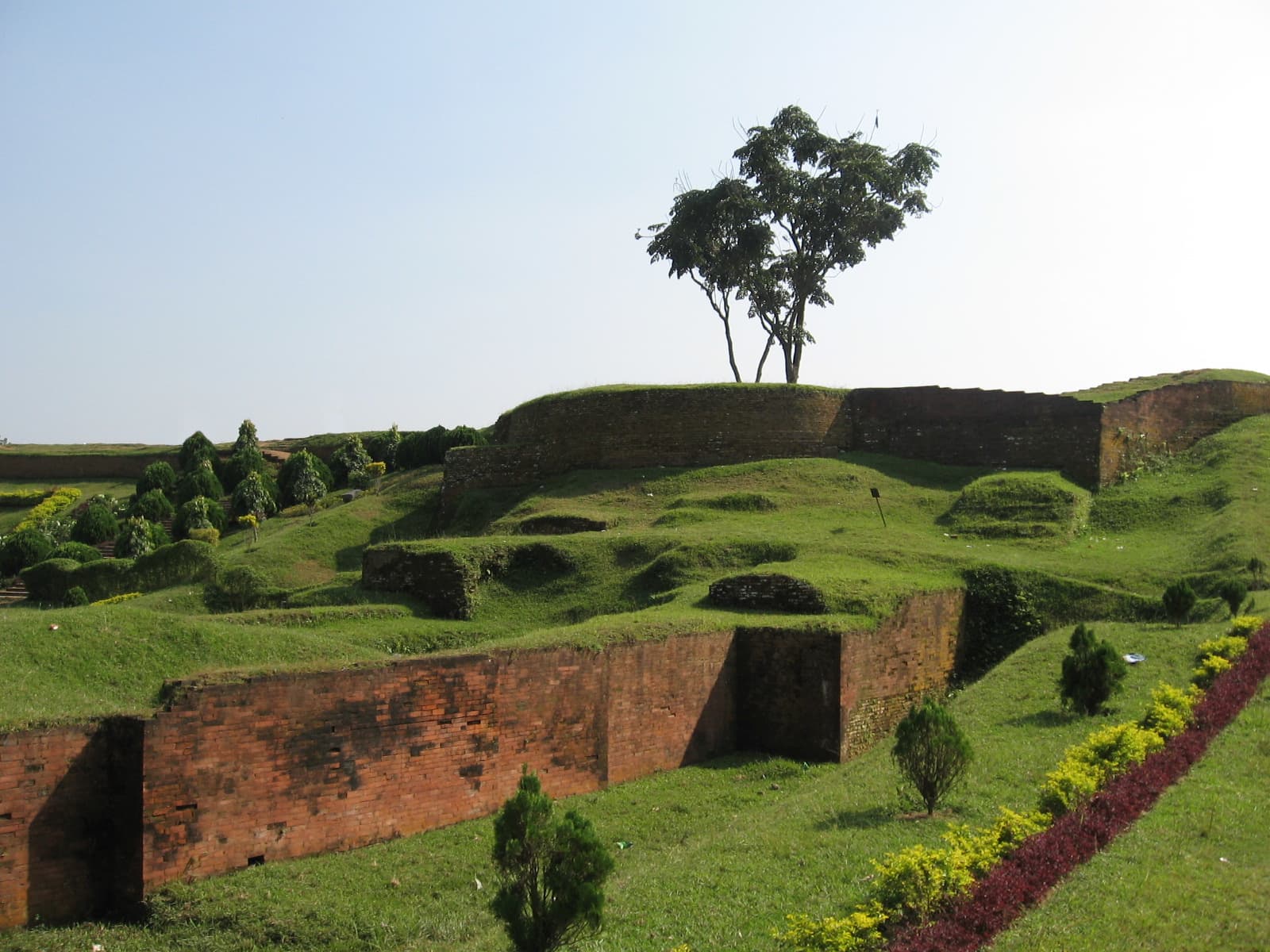
Mahasthangarh: Exploring Bangladesh’s Ancient Citadel and Earliest Urban Settlement
Wander the vast earthen ramparts and excavated ruins of this 2,500-year-old site that once anchored the Pundravardhana kingdom.
Why Mahasthangarh Matters
Mahasthangarh preserves the remains of Pundranagara, one of the earliest cities in Bengal and the capital of the ancient Pundravardhana region. The fortified citadel, enclosed by a massive earthen rampart and moat, stretches more than a kilometer along the Karatoya River and contains layers of occupation from the Mauryan period onward. Buddhist monasteries, Hindu temples, and everyday artifacts recovered here trace the shifting religious and commercial life of the Bengal delta for over two millennia.
What to See on Site
The Citadel and Ramparts
Begin with a circuit of the high earthen walls that still rise several meters above the surrounding fields. The original gates are marked by depressions in the rampart; walking the full perimeter reveals how the city was protected from both floods and invaders.
Excavated Structures
- Govinda Bhita: a terraced temple mound overlooking the river with clear brick alignments.
- Bairagir Bhita: remains of a monastery complex showing successive building phases.
- Khulnar Dhap and Mankalir Dhap: smaller mounds that yielded Buddhist stupas and Hindu sculptures now displayed in the site museum.
Site Museum
The small museum houses terracotta plaques, stone images of Vishnu and Buddha, coins, and pottery that illustrate daily life and artistic styles across centuries. Labels place each object within the broader story of the site’s continuous occupation.
Getting There and Getting Around
Most visitors reach Mahasthangarh from Bogura town, a 20-minute drive north on the Rangpur highway. Local buses and shared auto-rickshaws run regularly from Bogura’s central stand; hiring a car for the day allows stops at several mounds without backtracking. Inside the archaeological zone, paths are unpaved, so sturdy shoes and a hat are essential.
Best Time to Visit
The dry months from November through February offer comfortable temperatures and firm ground for walking. Monsoon rains from June to September turn the moat and fields into mud, limiting access to the outer ramparts.
Nearby Places Worth Combining
Travelers often pair the site with a visit to the larger Somapura Mahavihara at Paharpur, roughly two hours away, or the riverside town of Bogura itself, known for its yogurt and as a gateway to northern Bangladesh.