History and Significance
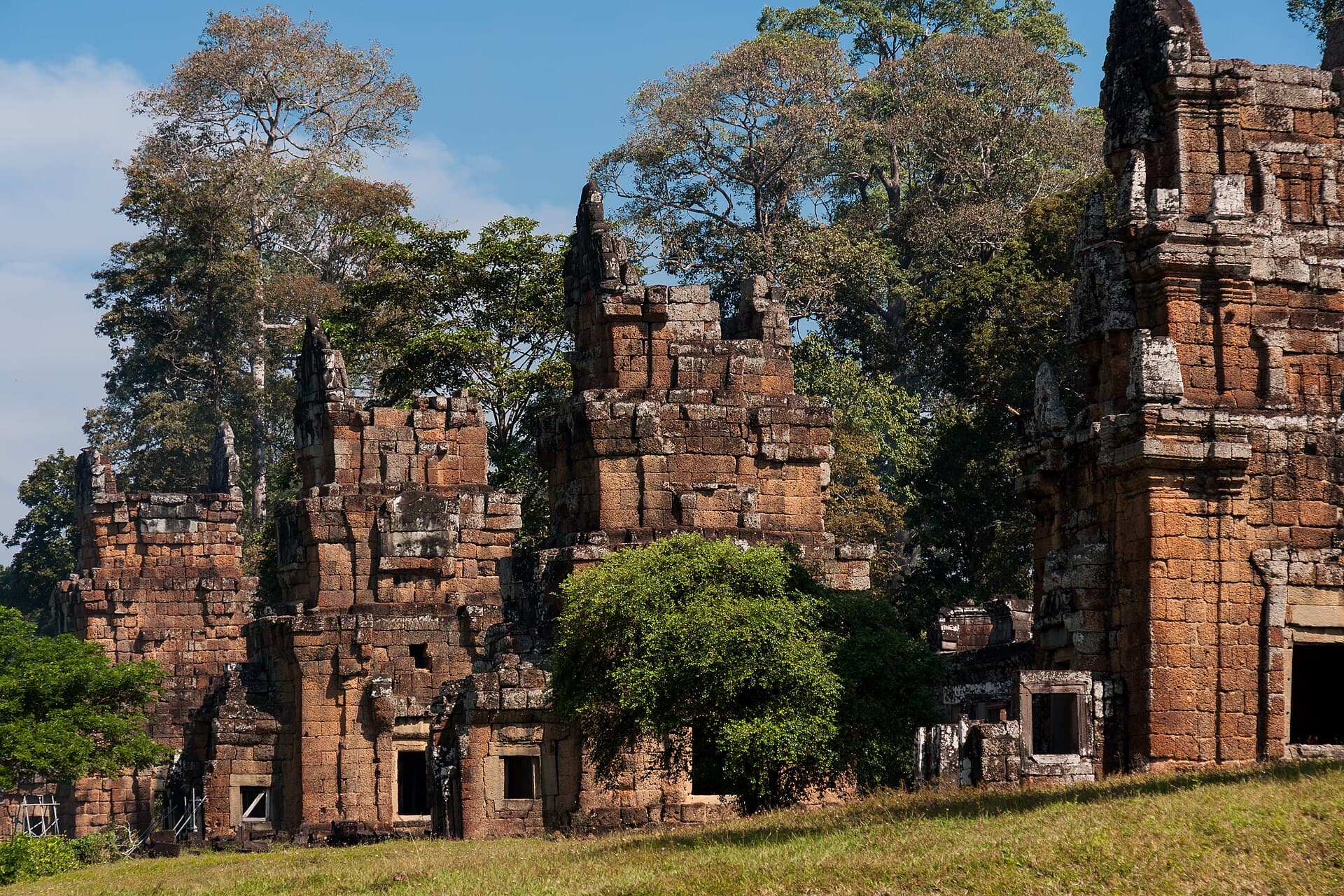
The Terrace of the Leper King forms part of the royal enclosure within Angkor Thom, built during the late 12th century under King Jayavarman VII. Its name derives from a seated statue discovered here whose surface shows pitting once mistaken for leprosy; the figure is now understood to represent Yama, the Hindu god of death, or possibly a deified king. The terrace’s true value lies in its extensive sandstone galleries that wrap around three sides, carved with layered scenes of mythical beings, processions, and daily life that survive in remarkable detail.
What to See and Do
Walk the upper terrace first to view the outer gallery’s deep reliefs showing multi-headed nagas, garudas, and apsaras interspersed with elephants and horses. Descend the narrow staircase to the inner gallery, where a second set of carvings remains sheltered and better preserved. The central platform holds the Leper King statue (a replica; the original resides in Phnom Penh’s National Museum). Allow time to trace the continuous narrative bands that depict both celestial and terrestrial realms, a level of storytelling rarely matched at other Angkor sites.
Getting There
The terrace lies inside Angkor Thom’s northern wall, a short walk north of the Terrace of the Elephants and east of the Bayon. Most visitors arrive by tuk-tuk or bicycle along the main circuit road; those staying in Siem Reap can combine it with a full-day pass covering the entire Angkor Archaeological Park. Paths are level but sandy in places, so sturdy footwear helps.
Best Time to Visit
November through February offers the driest weather and clearest light for photography, though mornings before 9 a.m. or late afternoons after 3 p.m. reduce both heat and tour-group crowds. The rainy season (June–October) brings fewer visitors but slippery surfaces and occasional flooding on access paths.
Nearby Attractions
Combine a visit with the adjacent Terrace of the Elephants, the Baphuon temple, and the royal palace grounds. A short walk north leads to the Preah Palilay temple, while the Victory Gate provides a quieter exit route back toward the east baray. These sites together reveal the urban layout of Angkor Thom far better than any single monument.