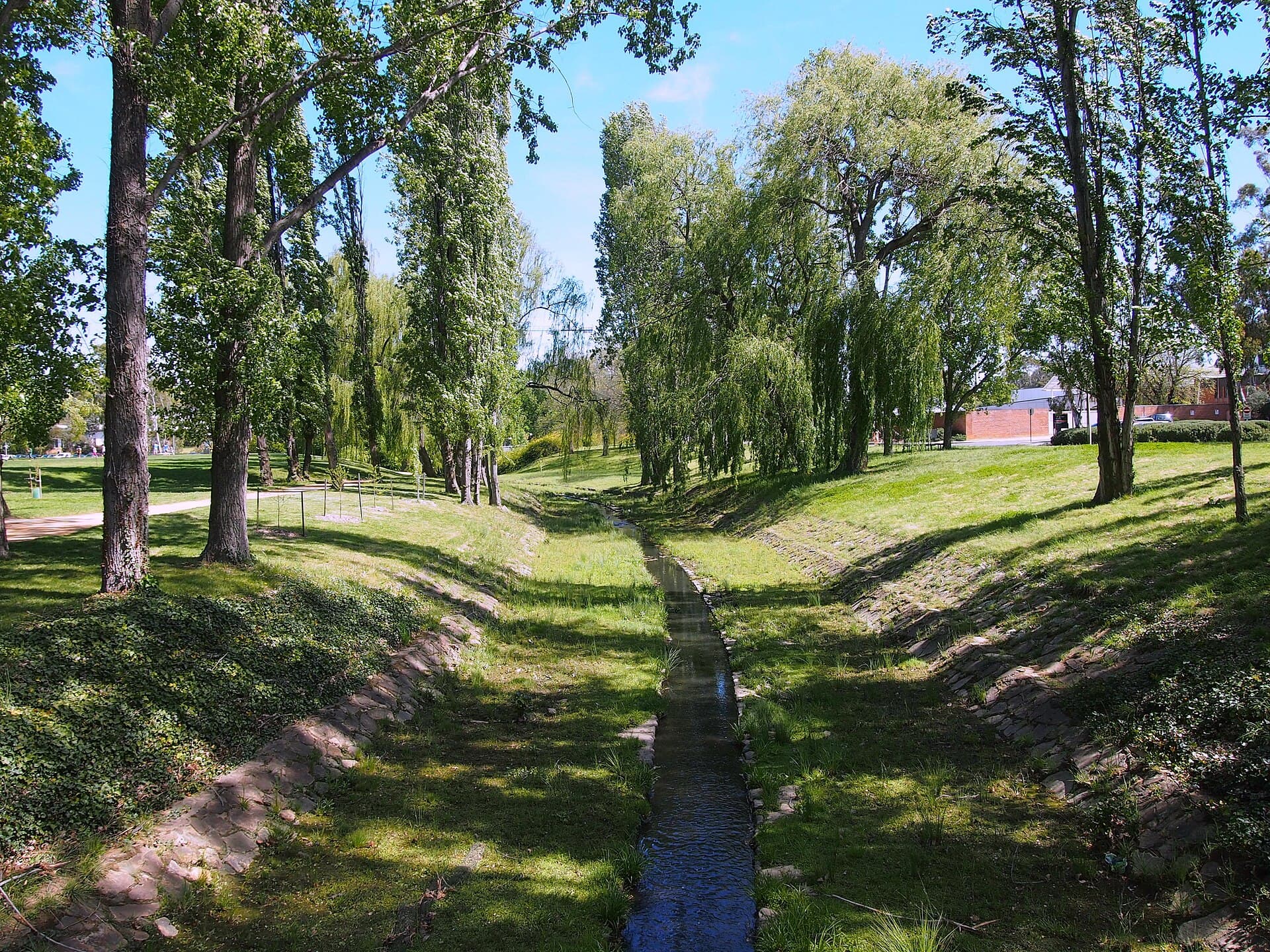
Discovering Sullivans Creek
Sullivans Creek rises in the hills north of Canberra and winds southward for roughly ten kilometres, passing through suburban parkland before entering the Australian National University campus and finally meeting Lake Burley Griffin. The creek’s tree-lined banks and adjacent shared paths create a linear green corridor that feels surprisingly wild within the capital.
Walking and Cycling the Corridor
A well-maintained shared path runs almost the entire length, suitable for casual strolls, jogging or cycling. From the northern suburbs the trail descends through open grasslands dotted with eucalypts, then enters the denser plantings around the university. Look for eastern grey kangaroos grazing at dawn or dusk and a variety of waterbirds including Pacific black ducks, white-faced herons and occasional spoonbills along the reed-fringed lower reaches.
Best Time to Visit
Canberra’s climate favours spring (September–November) and autumn (March–May) when temperatures are mild and wildflowers or autumn foliage add colour. Summer visits are possible early in the morning before heat builds; winter walks are crisp but sunny days remain pleasant.
Getting There and Getting Around
Multiple bus routes serve stops along Northbourne Avenue and near the ANU, while dedicated bike lanes connect the creek path to the city centre and Lake Burley Griffin foreshore. On-street parking is available at several access points including O’Connor Ridge and the university’s northern boundary. The entire corridor is flat, making it accessible for most mobility levels.
Nearby Attractions
At the southern end the creek meets the lake, placing visitors minutes from the National Museum of Australia, Questacon and the Parliamentary Triangle. Northward, the path links to the Mount Ainslie and Black Mountain nature reserves for longer hikes.
Practical Considerations
The creek is not suitable for swimming due to variable water quality. After heavy rain some sections can flood briefly; check local alerts before setting out. Carry water, sun protection and insect repellent, especially near the lower wetlands.