History of Srah Srang
Constructed in the mid-10th century under King Rajendravarman II, Srah Srang served as the royal bathing pool for the nearby palace at Pre Rup. Later expanded in the 12th century during the reign of Jayavarman VII, the reservoir was lined with laterite and sandstone and fed by a canal connected to the East Baray. Its name, meaning “Pool of Ablutions,” reflects its ceremonial role for the king and court.
Architectural Highlights
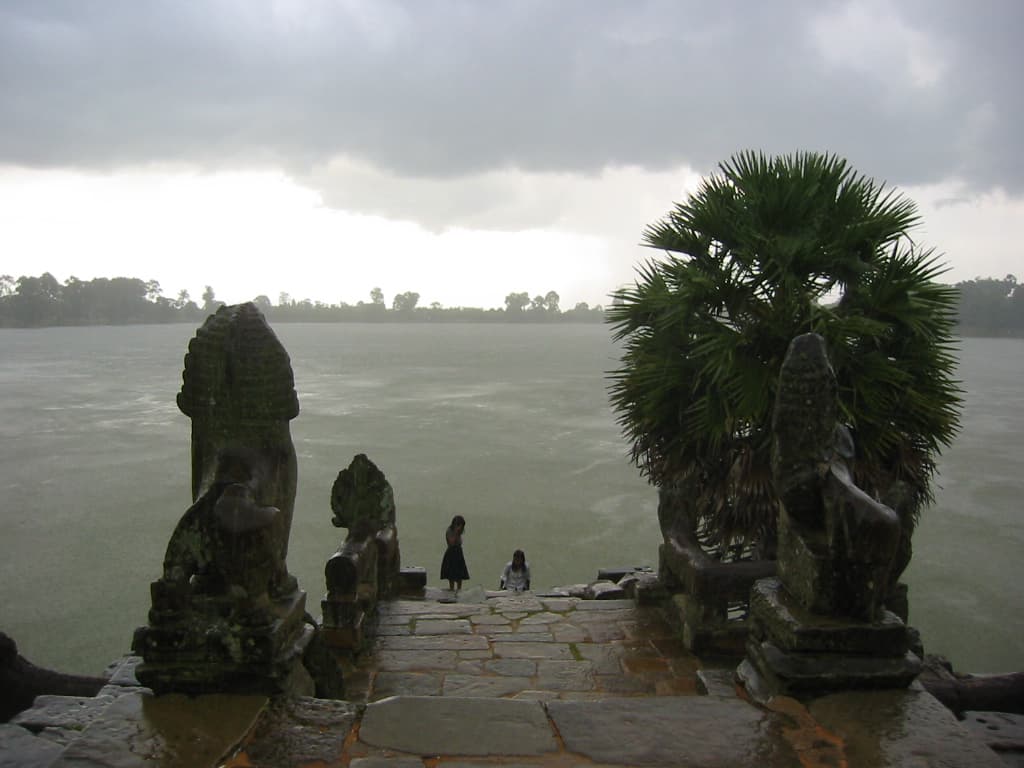
The standout feature is the western stone terrace that projects into the water. Carved nagas with multiple heads form balustrades, while pairs of guardian lions sit at the corners. At sunrise the terrace creates striking reflections of the sky and surrounding trees. The reservoir itself measures roughly 300 by 700 meters and remains largely intact, unlike many other Angkor barays that have silted in.
Visiting the Site
Walk the full length of the western embankment for the best views, then descend the central staircase to the water’s edge. The site is rarely crowded, making it an ideal place to pause between larger temple complexes. Monks from the nearby monastery sometimes walk the paths at dawn, adding to the contemplative atmosphere.
How to Reach Srah Srang
The reservoir lies on the main Angkor temple circuit, a short distance east of Banteay Kdei and south of Ta Prohm. Most visitors arrive by tuk-tuk, bicycle, or organized tour from Siem Reap. The site is included in the standard Angkor Archaeological Park pass; no separate ticket is required.
Best Time to Visit
The dry season from November through February offers the clearest skies and coolest mornings. Arrive at first light to photograph the terrace before tour groups arrive and to enjoy cooler temperatures. The rainy season brings lush vegetation but also mosquitoes and muddy paths after downpours.
Nearby Attractions
- Banteay Kdei – a compact Buddhist temple just 200 meters west, perfect to combine in one visit.
- Ta Prohm – the famous “Tomb Raider” temple, a 10-minute walk north.
- East Mebon – an island temple rising from the now-dry East Baray, reachable by a short ride east.