
Keep reading
Nearby & related
Tsodilo Hills: Botswana’s Ancient Rock Art and Sacred Landscape
Discover the UNESCO-listed Tsodilo Hills, where thousands of San rock paintings and four dramatic peaks create one of…
12 October 2026
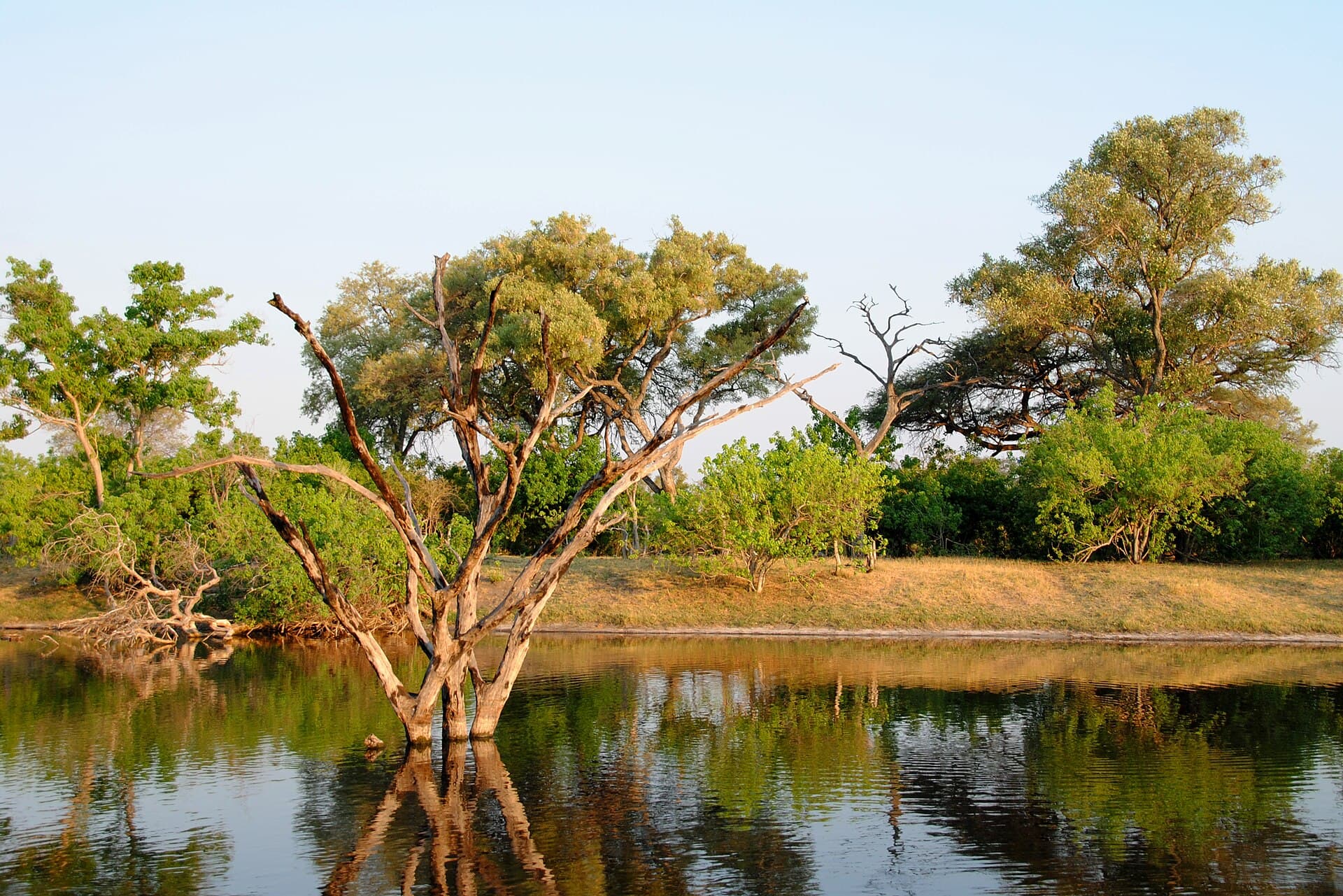
Follow the shifting waters of the Savuti Channel through Chobe National Park for concentrated predator and elephant sightings.
The Savuti Channel cuts across the western edge of Chobe National Park, delivering water only when rainfall in Angola and Zambia is sufficient to push flow down the Linyanti system. When the channel fills, it transforms dry savanna into a ribbon of green that draws thousands of elephants, buffalo, and predators. When it dries, the same landscape becomes a dustbowl where animals concentrate at shrinking pools, creating some of Botswana’s most reliable big-cat viewing.
Elephant herds numbering in the hundreds move between the channel’s pools and the surrounding mopane woodland. Lions here have adapted to hunt elephant calves, a behavior rarely seen elsewhere. Cheetah use the open grasslands south of the marsh, while African wild dogs den in the mopane. Birdlife peaks when water returns: saddle-billed storks, wattled cranes, and large flocks of pelicans appear on the shallow floodplains.
At the channel’s southern end lies the Savuti Marsh, a vast grassy depression that floods irregularly. Game drives along its eastern and western shores offer uninterrupted views of grazing animals. The marsh edges are also prime spots for spotting nocturnal species on night drives.
Most visitors fly into Kasane or Maun, then transfer by light aircraft to Savuti Airstrip. From the airstrip, lodges collect guests in open 4×4 vehicles. Self-drivers require high-clearance vehicles and must cross deep sand on the 120 km track from Savuti Gate; a second vehicle or recovery equipment is strongly advised.
The dry months from May to October bring the highest wildlife density as animals depend on the remaining channel water. Peak concentrations occur in September and October. November rains can close tracks and disperse animals, while the brief green season from December to April offers fewer visitors and dramatic thunderstorm skies but requires flexible plans.
Savuti sits between the Linyanti Reserve to the north and the drier Mababe Depression to the south. Multi-day itineraries commonly link Savuti with the Chobe Riverfront or Moremi Game Reserve for contrasting habitats.
No. Flow depends on rainfall far upstream in Angola and can remain dry for years, then suddenly refill for a decade or more.
Deep sand and occasional flood damage make the track unsuitable for anything less than a proper high-clearance 4x4 with low-range gearing.
Several artificial boreholes and natural seeps remain, but they are spaced far apart; plan game drives around these known locations.
Coverage is patchy or nonexistent; inform your lodge of your expected arrival time and carry a satellite communicator for emergencies.
Roughly 120 km by road or a short flight; most visitors combine both areas on a 5- to 7-day itinerary.
Keep reading
Discover the UNESCO-listed Tsodilo Hills, where thousands of San rock paintings and four dramatic peaks create one of…