
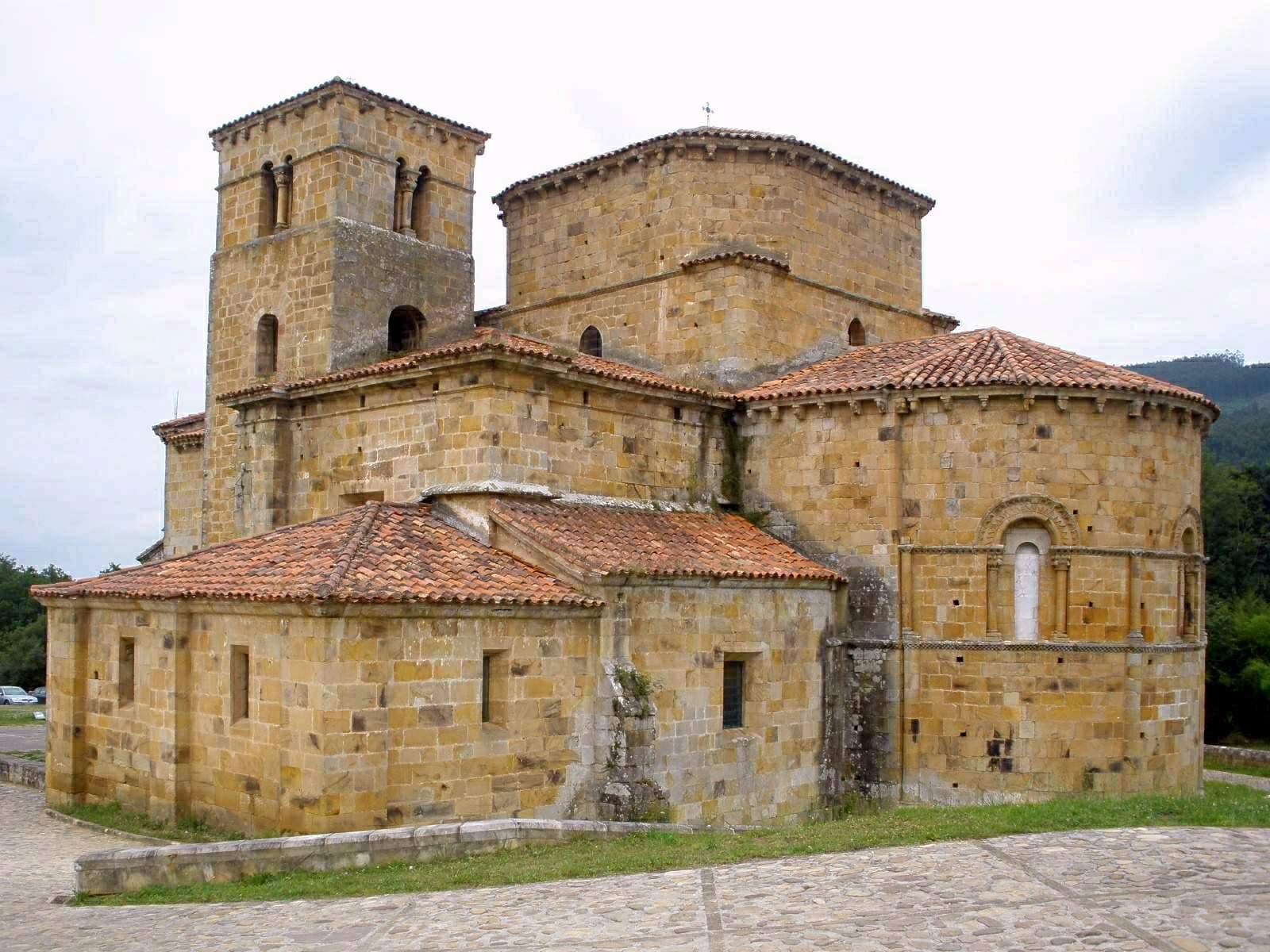
The Collegiate Church of Santa Cruz de Castañeda: Cantabria’s Romanesque Masterpiece
A 12th-century monument whose sculpted portals and rural setting reveal the layered history of northern Spain.
Why This Collegiate Church Stands Out
The Collegiate Church of Santa Cruz de Castañeda rises from a quiet valley in the municipality of Castañeda, its stone bulk framed by green hills and distant peaks of the Cantabrian range. Built in the mid-12th century, the church preserves one of the region’s most complete Romanesque ensembles, notable for the dense narrative sculpture that covers its south portal and the balanced proportions of its three-aisled interior.
Architectural Highlights
Approach the south façade first. Here, concentric arches frame biblical scenes and vegetal motifs carved with unusual depth; look for the repeated motif of intertwined vines that local masons adapted from earlier Asturian models. Inside, the nave retains its original barrel vaulting over the central aisle and groin vaults above the side aisles. A 16th-century altarpiece now occupies the apse, yet the earlier Romanesque capitals remain visible along the triforium, each one depicting different pairs of animals and human figures.
Getting There
Most visitors arrive by car. From Santander, take the A-8 motorway west for 25 km, then exit toward Torrelavega and follow the CA-135 into the valley. The monument sits just outside the village center; a small parking area lies 200 m from the main entrance. Those traveling from Bilbao can reach the site in roughly 90 minutes via the same motorway. Public buses serve the nearby town of Cartes, from which a 4 km taxi or rural road walk completes the journey.
Best Time to Visit
Spring (April–June) and early autumn (September–October) offer the mildest weather and clearest light for photography. Summer brings lush vegetation but occasional tour groups; winter visits are possible yet require sturdy footwear because the stone floors stay damp.
Nearby Attractions
Combine the visit with the medieval town of Santillana del Mar, 12 km north, or the prehistoric paintings at the Caves of Altamira, 15 km away. Hikers can follow the GR-121 trail that passes through Castañeda’s oak woods and connects to the larger Picos de Europa network.
Visitor tips
- Wear shoes with good grip; the uneven flagstones inside the church and the gravel paths outside become slippery after rain.
- Allow at least 45 minutes for unhurried viewing of the portal carvings and interior capitals; the site rewards slow observation rather than a quick pass-through.
- Pair the visit with lunch in nearby Cartes or Santillana del Mar, where traditional Cantabrian cider houses serve local cheeses and anchovies.
Frequently asked questions
Is the Collegiate Church of Santa Cruz de Castau00f1eda still used for worship?
Yes, the church remains an active parish; respectful silence is expected during services, which usually occur on weekends.
Can I take photographs inside the monument?
Photography without flash is permitted in the nave and side aisles; tripods are not allowed to protect the stone surfaces.
Are there facilities such as restrooms or a cafu00e9 on site?
No permanent cafu00e9 exists at the church itself; the nearest services are in the village of Castau00f1eda, a five-minute walk away.
Is the site suitable for visitors with reduced mobility?
The main entrance involves several stone steps and the interior floor is uneven; wheelchair access is limited to the exterior forecourt.
What makes the sculpture on the south portal unique?
The carvings combine biblical narratives with local flora and fauna motifs, showing a transition between Romanesque and early Gothic styles that is rare in Cantabria.