
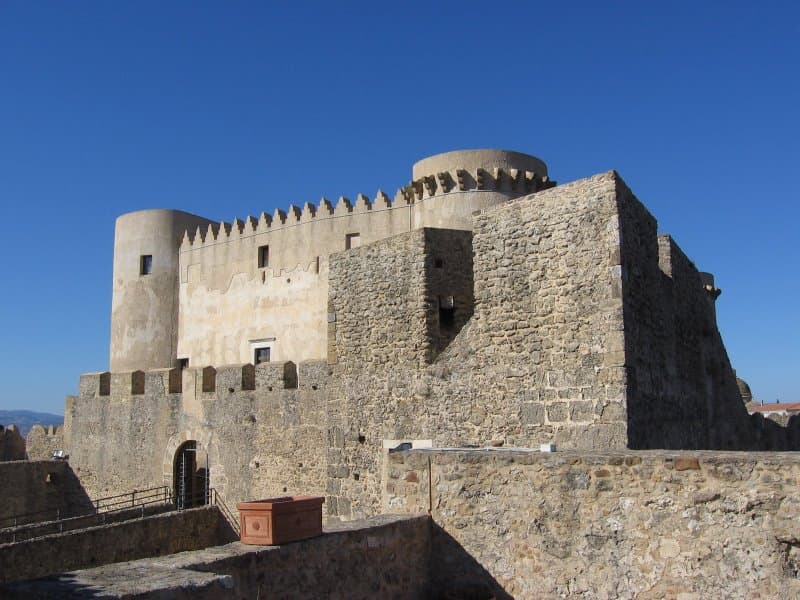
The Castle of Santa Severina: Norman Fortress Overlooking Calabria’s Neto Valley
A hilltop stronghold blending Byzantine roots and Norman stonework, the Castle of Santa Severina rewards visitors with panoramic views and quiet medieval streets.
Why This Castle Stands Out
Santa Severina’s castle rises from a steep limestone spur above the Neto River valley, its massive walls and round towers shaped by successive Byzantine, Norman, and Angevin rulers. Unlike coastal fortresses built for naval defense, this inland stronghold controlled inland trade routes between the Ionian Sea and the Sila mountains. Today the restored complex houses a small civic museum and offers unobstructed sightlines across olive groves and distant peaks.
Getting There
The castle sits inside the compact historic center of Santa Severina, reachable by car via the SS107 from Crotone (about 35 minutes) or the SS109 from Catanzaro. Limited parking lies just below the walls; from there a short but steep footpath leads to the main gate. Regional buses stop in the lower town, after which visitors climb the winding alley known as Via Castello.
What to See and Do
Inside the Walls
Walk the ramparts for 360-degree views, then descend into the courtyard where exposed Norman masonry meets later Angevin additions. The museum displays local ceramics, coins, and architectural fragments that trace the site from the 9th century onward. A small chapel inside the keep preserves faded fresco fragments.
The Surrounding Town
After the castle, continue to the nearby Byzantine cathedral with its 11th-century crypt and the compact Arab-Norman quarter of narrow vaulted lanes. A short walk downhill reaches the 16th-century Palazzo Zagarese, now used for occasional exhibitions.
Best Time to Visit
Spring (April–June) and autumn (September–October) bring mild temperatures ideal for walking the ramparts and exploring the town without summer heat or winter wind. Early morning visits avoid tour groups and capture soft light on the valley.
Nearby Attractions
- The Norman castle at Crotone, 30 minutes east, for comparison of coastal fortifications.
- The Sila National Park, roughly an hour north, for hiking and lakes.
- The Greek ruins at Capo Colonna, reachable in under an hour by car along the Ionian coast.
Visitor tips
- Wear sturdy shoes; the final approach to the castle and the rampart walk involve uneven stone surfaces and steps.
- Combine the castle visit with a stroll through Santa Severinau2019s historic center, which can be fully covered on foot in two hours.
- Bring water and a hat; shade is limited on the exposed walls even on cooler days.
Frequently asked questions
Is the Castle of Santa Severina wheelchair accessible?
Only the ground-level courtyard and museum rooms are accessible; the ramparts and upper keep require climbing steep stairs and are not suitable for wheelchairs.
How long should I plan to spend at the castle?
Most visitors spend 60u201390 minutes exploring the walls, courtyard, and museum; add another hour to wander the adjacent historic lanes.
Can I visit without a car?
Yes, but expect a 15-minute uphill walk from the bus stop in the lower town; taxis are available from Crotone if needed.
Are there restrooms or cafu00e9s inside the castle?
A small cafu00e9 operates in the lower courtyard during peak months; public restrooms are located just outside the main gate.
What should I wear for a visit?
Comfortable walking shoes, sun protection, and a light jacket for windy days on the ramparts are recommended year-round.