
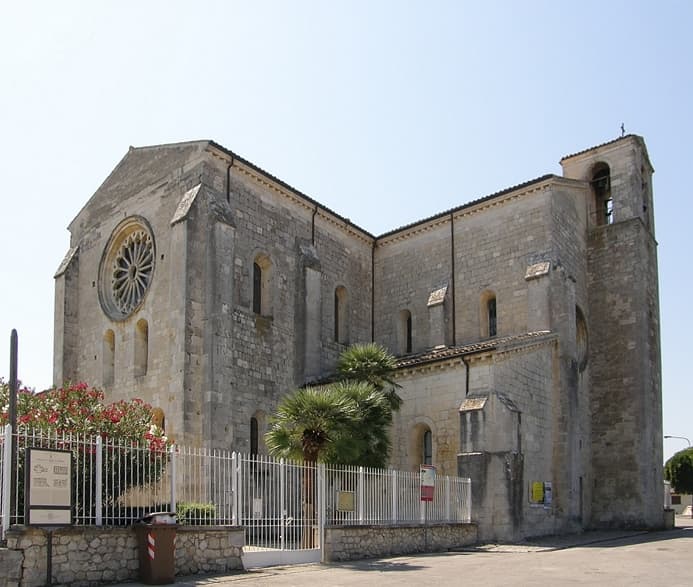
Santa Maria Arabona: Medieval Cistercian Abbey Church in Manoppello
Explore the graceful Romanesque-Gothic architecture and tranquil cloister of this 13th-century Abruzzo abbey set amid olive groves and hills.
Introduction to Santa Maria Arabona
Santa Maria Arabona stands as one of Abruzzo’s finest surviving Cistercian monuments, a 13th-century abbey church whose sober stonework and elegant proportions reflect the order’s emphasis on simplicity and light. Located just outside Manoppello in the Pescara Valley, the site offers visitors a quiet counterpoint to the region’s more famous pilgrimage centers.
Architecture and Artistic Highlights
The church follows a Latin-cross plan with a single nave, transept, and three apses. Its most striking feature is the rose window above the portal, framed by delicate stone tracery that shows early Gothic influence arriving from France via the Cistercian network. Inside, the ribbed vaulting and slender columns create a luminous interior where sunlight shifts across the pale limestone throughout the day. The adjacent cloister, though partially rebuilt, retains original capitals carved with geometric and vegetal motifs typical of Abruzzese workshops.
Historical Context
Founded around 1208 by monks from the nearby abbey of Casanova, Arabona quickly became a local center of agriculture and manuscript production. The complex endured earthquakes and later suppressions yet preserves enough original fabric to convey the daily rhythm of medieval monastic life.
Planning Your Visit
The church sits on a low rise surrounded by olive groves and vineyards, best reached by car from Manoppello’s historic center in about ten minutes. Public buses run infrequently, so renting a vehicle or joining a guided tour from Pescara is practical. Spring and autumn deliver mild temperatures ideal for lingering in the cloister and exploring the surrounding countryside; summer heat can make the stone surfaces glaring, while winter often brings crisp air and fewer visitors.
Nearby Attractions
Combine a visit with the Sanctuary of the Holy Face in Manoppello, home to the celebrated veil relic, or continue to the hill town of Chieti for its archaeological museum. The nearby Gran Sasso massif offers hiking trails and the medieval village of Castel del Monte for those extending their stay.
Practical Considerations
- Comfortable walking shoes are essential for the uneven stone floors and surrounding paths.
- Modest dress is appreciated inside the church, especially during occasional services.
- Allow at least ninety minutes to absorb both the interior and the cloister at a contemplative pace.
Visitor tips
- Visit in the late afternoon when the rose window catches the setting sun and the interior glows with warm light.
- Pair the abbey with a stop at a local olive-oil producer in the Pescara Valley for an authentic taste of Abruzzou2019s agricultural heritage.
- Check weather forecasts before traveling; the rural roads can become slippery after heavy rain.
Frequently asked questions
How do I reach Santa Maria Arabona from Pescara?
Drive north on the SS5 for roughly 25 minutes, then follow signs toward Manoppello; the abbey lies a short distance west of the town center.
Is the site suitable for visitors with mobility limitations?
The church floor is mostly level, but the cloister and exterior paths contain uneven stones and a few steps; assistance may be needed.
Can I attend a service at the abbey?
Occasional masses are held; visitors are welcome provided they respect the quiet atmosphere and dress modestly.
What is the best season to photograph the abbey?
Late spring and early autumn offer soft light, blooming or harvest scenery, and fewer shadows on the stone fau00e7ade.
Are there dining options nearby?
Manoppellou2019s town center has several family-run trattorias serving Abruzzese specialties; the abbey itself offers no on-site refreshments.