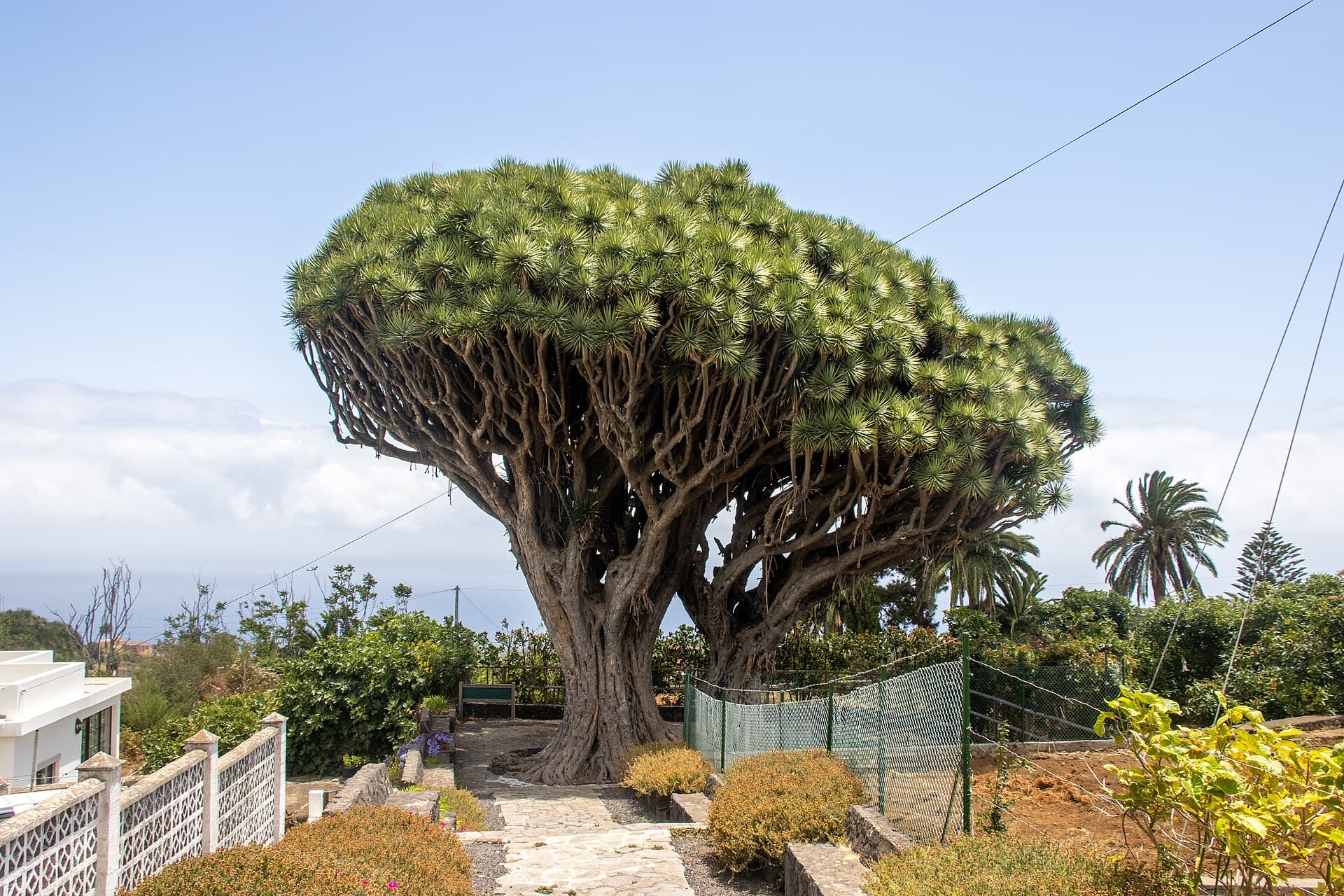
What Makes Dragos Gemelos Special
Dragos Gemelos are a pair of mature dragon trees (Dracaena draco) growing close together on a terraced hillside above the village of El Jesús in La Palma’s Tazacorte municipality. Their thick, umbrella-shaped canopies and knotted trunks have become a recognizable symbol of the island’s unique flora, which evolved in isolation on the Canary archipelago.
The Dragon Tree in Canary Culture
Local lore links dragon trees to the pre-Hispanic Benahoare people, who used the red resin—known as “dragon’s blood”—for dyes, medicines, and rituals. Today the trees are protected under regional law; visitors may approach only on established paths to prevent root damage and soil compaction.
Getting There
From Los Llanos de Aridane, follow the LP-2 road west toward Tazacorte and turn onto the narrow lane signed “Dragos Gemelos.” A small parking area sits at the trailhead. The final 400 m is a gentle, well-marked footpath that climbs through almond and banana terraces. No public transport reaches the site directly; taxis from Los Llanos take roughly 15 minutes.
Best Time to Visit
La Palma’s mild maritime climate allows visits year-round. Winter and spring (December–May) bring cooler temperatures and fewer visitors, while the trees’ flowering spikes appear most reliably in late summer. Early morning light is best for photography; afternoon trade-wind clouds can obscure views.
Practical Considerations
- Paths are unpaved and can be slippery after rain.
- Carry water; no facilities exist at the viewpoint.
- Stay on the marked trail—off-path walking damages fragile volcanic soil.
Nearby Attractions
Combine a visit with the mirador at El Time for sweeping views over the western banana plantations, or continue south to the lava fields of the 1949 San Juan eruption. The coastal path from Puerto de Tazacorte offers easy walking and black-sand beaches within a 20-minute drive.