
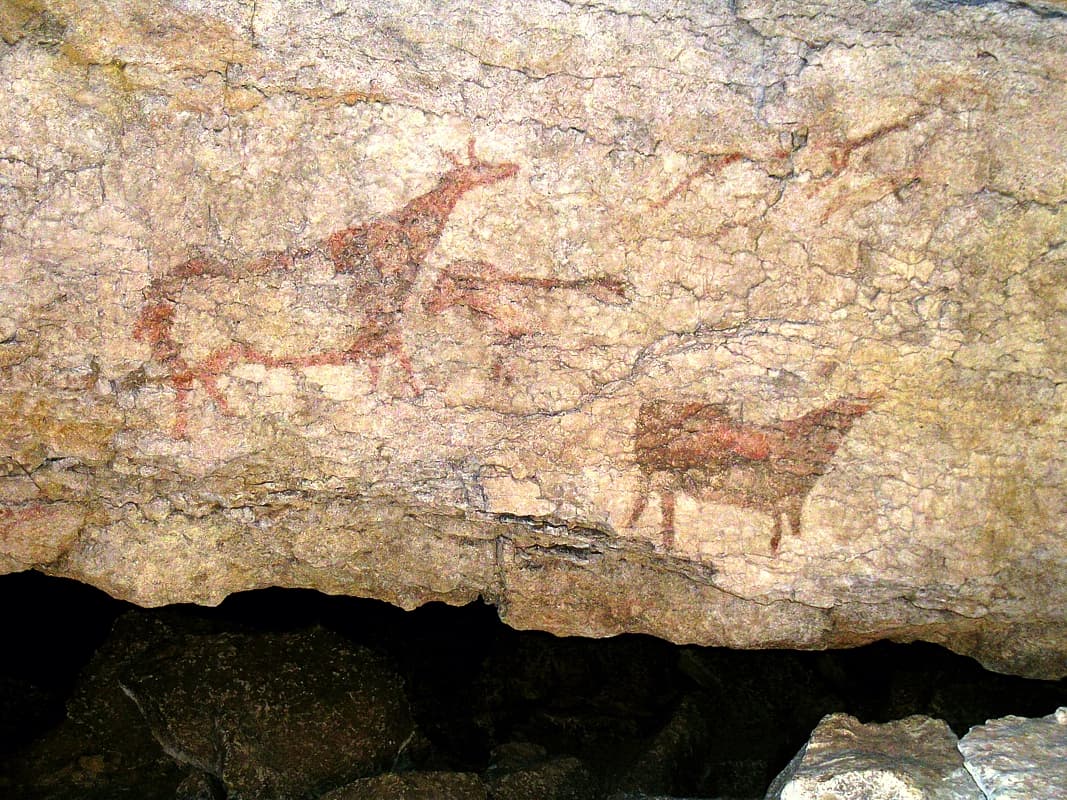
Cueva de El Pendo: Cantabria’s Paleolithic Sanctuary of Rock Art
Discover the layered prehistoric heritage and striking Magdalenian engravings inside this Cantabrian cave.
Why Cueva de El Pendo Matters
Hidden in the Real Valle de Camargo, Cueva de El Pendo preserves one of the longest continuous records of human presence in northern Spain, spanning the Lower Paleolithic through the Bronze Age. Its main chamber contains a monumental frieze of engraved and painted red deer, goats, and horses created around 20,000 years ago, demonstrating sophisticated Magdalenian artistic techniques that differ from the better-known polychrome bison at nearby Altamira.
What Visitors Experience Inside
Guided routes follow a gentle slope into a spacious, well-lit gallery where the 15-meter frieze dominates the right-hand wall. Subtle lighting reveals overlapping engravings that reward slow observation; smaller side chambers display earlier hand stencils and simple linear motifs. The cave’s stable temperature and natural acoustics allow visitors to appreciate how sound and light may have been used during ancient rituals.
Practical Route from Santander
The site lies roughly 15 kilometers southwest of Santander. Most travelers drive via the A-67 and CA-231, parking in the free lot beside the visitor center. Regional buses stop in Escobedo de Camargo, from which a marked footpath climbs 800 meters to the entrance. Taxis are readily available at the station and can wait for return trips.
Best Time to Visit
Spring (April–June) and autumn (September–October) offer mild temperatures and fewer school groups. Summer visits remain comfortable inside the cave but require earlier arrival to avoid midday queues. Winter visits are possible on drier days when paths are less muddy; the interior remains accessible year-round except during rare flooding events.
Nearby Places Worth Combining
- Parque de las Cuevas de Altamira – 25 minutes by car, home to the famous painted ceiling and its replica museum.
- Playa de Liencres – wide sandy beach ideal for a post-cave picnic or coastal walk.
- Santander’s Museo de Prehistoria y Arqueología – compact collection of regional artifacts that contextualizes finds from El Pendo.
Combining the cave with a morning visit to Altamira and an afternoon at the beach creates a balanced full-day itinerary without excessive driving.
Visitor tips
- Wear sturdy shoes with good grip; the path to the entrance includes a short uphill gravel section that can be slippery after rain.
- Book the official guided tour in advance during peak months, as group sizes are limited to protect the fragile surfaces.
- Allow at least two hours total: one hour for the cave itself and another for the interpretive panels and short film at the visitor center.
Frequently asked questions
How long is the tour inside Cueva de El Pendo?
The standard guided visit lasts about 50 minutes, including time to view the main frieze and smaller side panels at a comfortable pace.
Is photography allowed inside the cave?
No flash or tripod photography is permitted to protect the pigments; visitors may take non-flash images of the exterior and visitor center only.
Are there any steep stairs or difficult sections?
The path inside is mostly level with a few low steps and handrails; the route is considered accessible for visitors with moderate mobility.
Can I visit without joining a guided group?
Independent exploration is not allowed; all visitors must join a scheduled tour led by official guides who carry the necessary lighting and keys.
What else is there to do nearby if the cave visit is short?
The surrounding Camargo valley has pleasant walking trails, traditional cider houses in Escobedo, and the coastal dunes of Liencres beach a short drive away.