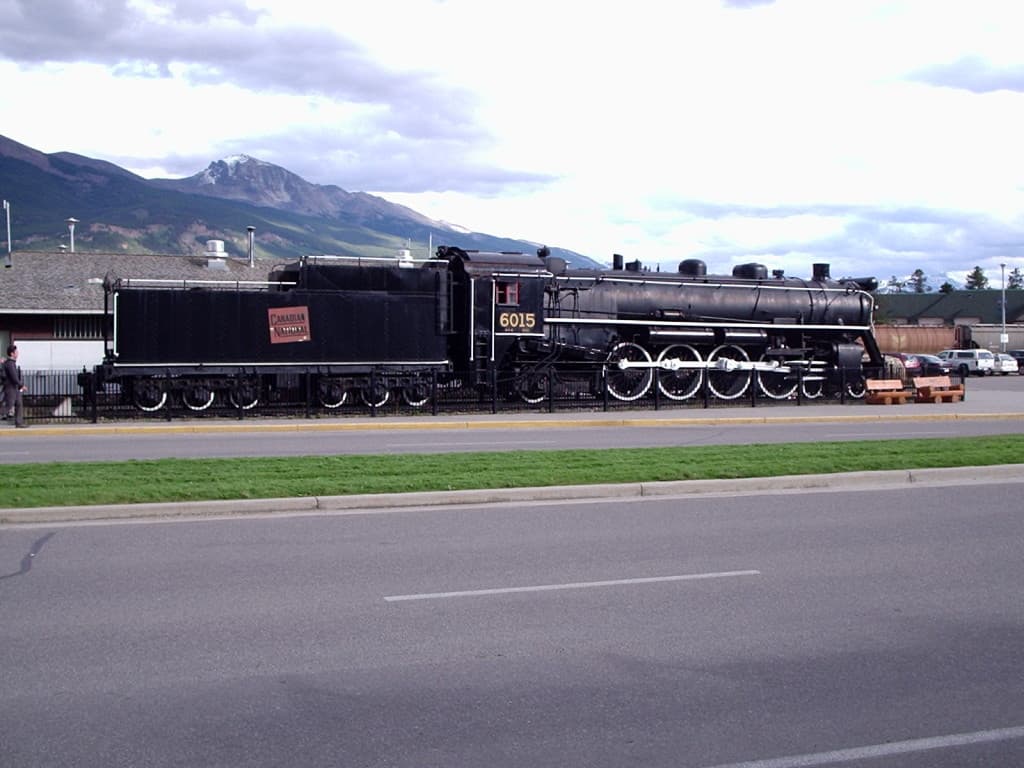
History of the CN Mountain Locomotive 6015
Built in the 1920s for Canadian National Railways, Locomotive 6015 was designed specifically for heavy-duty service through the steep grades of the Canadian Rockies. Its large driving wheels and powerful boiler allowed it to haul passenger and freight trains over the demanding terrain between Jasper and points east and west. Retired in the mid-20th century, the locomotive was placed on permanent outdoor display near Jasper’s railway facilities, where it remains one of the most accessible historic rail artifacts in the national park.
What Visitors Can Expect on Site
The locomotive sits outdoors on a short section of track, allowing close-up views of the massive cylinders, running gear, and tender. Interpretive panels explain the Mountain class design and the role these engines played in moving people and goods through Jasper National Park. Because the site is open-air, visitors can walk around the entire length of the engine and tender, photographing details such as the builder’s plate and the distinctive CN maple-leaf herald. The surrounding gravel and grass area provides space for families to linger without crowding.
Getting There and Practical Access
The locomotive is located within walking distance of Jasper’s historic railway station, making it an easy addition to any town-center itinerary. Travelers arriving by car will find free public parking along Connaught Drive and nearby side streets; from there a flat five-minute walk leads directly to the display. Those staying at hotels or campgrounds in the park can reach the site via the local Roam transit bus or by bicycle on the paved pathways that run parallel to the tracks. No special park pass is required simply to view the locomotive, though a Parks Canada pass is needed for deeper exploration of Jasper National Park.
Best Time to Visit
Late spring through early fall offers the most comfortable conditions for lingering outdoors and taking clear photographs. Summer days are long, with golden-hour light around 8 p.m. that highlights the engine’s green-and-black paint. Winter visits are possible but require warm clothing and awareness of icy paths; the locomotive is frequently dusted with snow, creating striking contrast against the surrounding peaks. Shoulder months of May and September typically deliver fewer visitors and milder temperatures than peak July and August.
Nearby Attractions Worth Combining
- Jasper Railway Station heritage building and its small museum exhibits
- Patricia and Pyramid Lakes for scenic drives or paddling after viewing the locomotive
- Trailheads for the Sulphur Skyline or Maligne Canyon hikes, both short drives from town
- The Jasper Tramway, which offers panoramic views of the same mountain ranges the locomotive once crossed
These sites together make an easy half-day or full-day itinerary centered on transportation history and mountain scenery.