
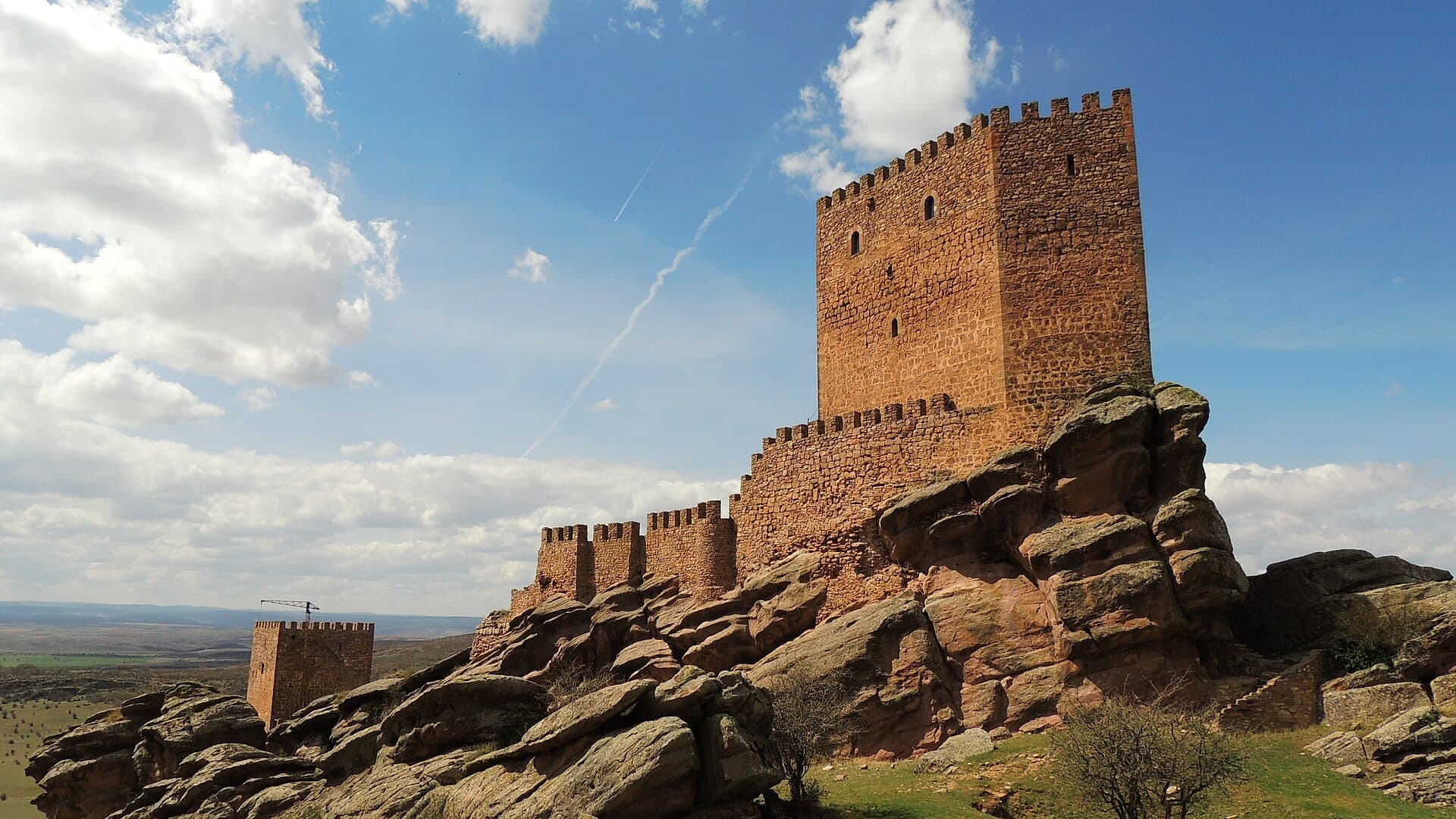
Castle of Zafra: Exploring the Isolated Medieval Stronghold in Castile-La Mancha
This 12th-century fortress stands alone on a sandstone ridge, offering hikers and history lovers a rare glimpse of unaltered medieval Spain.
Why Visit the Castle of Zafra
Perched on a steep rocky outcrop above the rolling plains of Guadalajara province, the Castle of Zafra remains one of Spain’s most atmospheric and least altered medieval fortifications. Its two square towers and connecting curtain walls rise directly from the sandstone, creating a silhouette that has changed little since the Reconquista era. Visitors climb a short but steep path to reach the interior, where original vaulted chambers and narrow arrow slits frame sweeping views across the Señorío de Molina countryside.
History and Architecture
Constructed in the late 12th or early 13th century, the castle served as a frontier outpost guarding the route between the kingdoms of Castile and Aragon. Its austere design—thick walls of local stone, minimal ornament, and cisterns carved into the rock—reflects its purely military purpose. Unlike many Spanish castles later converted into palaces, Zafra never received Renaissance additions, preserving its original defensive character.
What to See and Do
- Walk the perimeter path that circles the base of the outcrop for dramatic photographs.
- Enter the lower courtyard to examine the preserved cistern and original staircases cut into the rock.
- Climb to the upper battlements for 360-degree panoramas that stretch to the distant Serranía de Cuenca mountains on clear days.
- Allow time to sit quietly; the site’s extreme isolation means you often have the entire fortress to yourself.
Getting There
The castle lies roughly 3 km outside Campillo de Dueñas on an unpaved track. Most visitors arrive by car from Molina de Aragón (about 25 minutes) or from Guadalajara via the A-2 motorway. Public transport is limited; the nearest regular bus stop is in Molina, after which a taxi or bicycle is required. The final approach involves a 15-minute uphill walk on loose gravel, so sturdy shoes are essential.
Best Time to Visit
Spring (April–June) and autumn (September–October) offer mild temperatures and fewer insects. Summer brings intense sun with little shade, while winter can leave the access track muddy or snow-covered. Early morning visits are recommended year-round to avoid any midday heat and to capture the best light on the sandstone walls.
Nearby Attractions
Combine a visit with the Romanesque church in Campillo de Dueñas, the natural pools at the source of the Gallo River, or the larger castle ruins at Molina de Aragón. The region forms part of the unofficial “Route of the Forgotten Castles,” allowing travelers to link Zafra with several other remote fortifications in a single day’s drive.
Visitor tips
- Park at the signed trailhead and walk the remaining distance; the track is narrow and unsuitable for low-clearance vehicles after rain.
- Bring at least one liter of water per personu2014there are no facilities or shade once you leave the car.
- Check local weather the morning of your visit; strong winds on the ridge can make the battlements unpleasant or unsafe.
Frequently asked questions
Is the Castle of Zafra open every day?
Access is generally unrestricted, though the site is completely unstaffed and may be closed during extreme weather or for occasional maintenance.
How difficult is the walk to the castle?
The path is short but steep and rocky; most able-bodied visitors manage it in 10u201315 minutes, but it is not suitable for wheelchairs or strollers.
Can I stay overnight at the Castle of Zafra?
No overnight stays are permitted. The nearest accommodations are in Molina de Aragu00f3n or smaller villages such as Rueda de la Sierra.
Are there guided tours available?
No regular guided tours operate at the castle. Independent exploration is the norm; local tourist offices in Molina can provide basic maps and historical context.
Is photography allowed inside the towers?
Yes, photography is permitted throughout the site for personal use. Tripods are rarely needed on the uneven surfaces.