
Castillo de Belmonte: Exploring Spain’s Striking 15th-Century Star-Shaped Castle
Discover the imposing towers, layered defenses, and sweeping views of this exceptionally preserved fortress in the heart of La Mancha.
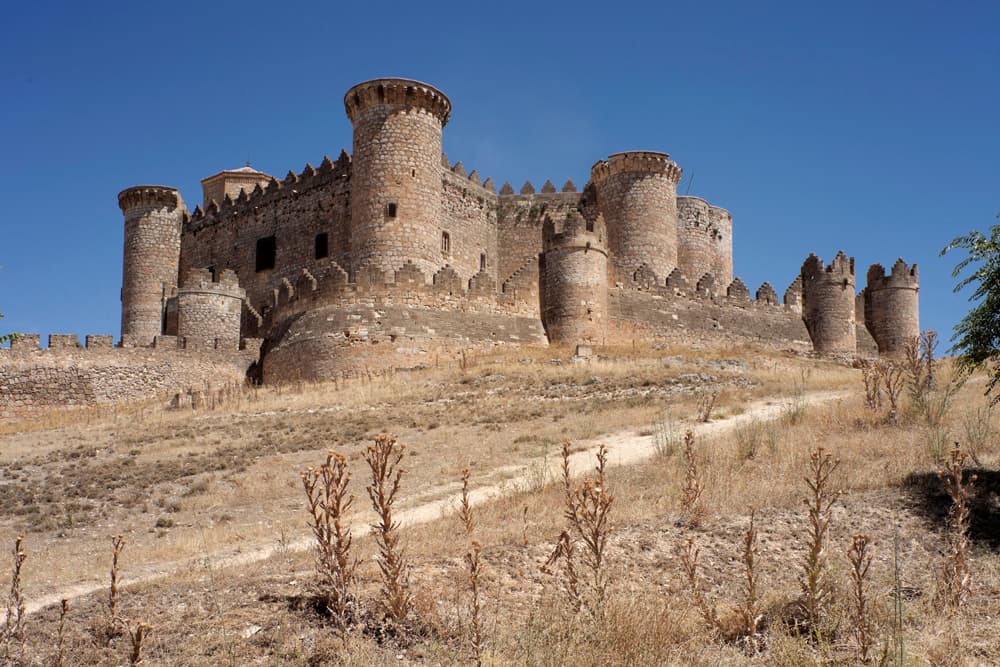
Castillo de Belmonte rises above the quiet town of Belmonte in Castile–La Mancha, a 15th-century fortress that remains one of the best-preserved medieval castles in Spain. Built between 1456 and 1470 by Juan Pacheco, Marquis of Villena, the castle was designed both for defense and to display noble power during the turbulent final decades of the Reconquista.
History and Strategic Location
The castle stands on a low hill at the edge of the La Mancha plain, positioned to guard the route between Toledo and Cuenca. Its pentagonal layout with five large round towers creates a distinctive star-like silhouette visible for kilometers across the flat countryside. After centuries of ownership changes and partial abandonment, the structure was restored in the 19th century and has since served as a filming location for several Spanish productions, adding to its cultural profile without altering its original military character.
What to See and Do
Visitors enter through the main gate into a series of concentric courtyards. The outer bailey contains stables and service buildings, while the inner keep houses the noble apartments, chapel, and armory. Climb the narrow staircases inside the towers for panoramic views over the red-tiled roofs of Belmonte and the surrounding vineyards and olive groves. The castle’s double curtain walls and deep moat illustrate late-medieval defensive engineering; look for the machicolations and arrow slits that remain intact. Guided tours, when available, usually focus on the transition from fortress to noble residence, highlighting the Mudéjar-influenced ceilings and Gothic windows.
How to Get There
Belmonte lies roughly 160 kilometers southeast of Madrid and 80 kilometers west of Cuenca. The most practical route is by car via the A-3 motorway, exiting at Honrubia and following local roads into town. Several regional bus services connect Belmonte with Cuenca and Albacete, though schedules are limited; renting a car allows easier exploration of nearby villages. Once in Belmonte, the castle is a short uphill walk from the main square.
Best Time to Visit and Nearby Attractions
Spring and autumn offer the most comfortable temperatures for walking the ramparts and exploring the town. Summer brings intense heat and occasional festival crowds, while winter can be cold and windy on the exposed hilltop. Combine a castle visit with the nearby Colegiata de San Bartolomé, a 16th-century collegiate church containing an impressive altarpiece, and the historic center’s Renaissance palaces. The surrounding La Mancha landscape also features windmills associated with Don Quixote, making the area ideal for a full-day itinerary of castles, churches, and literary heritage sites.
Visitor tips
- Wear sturdy shoes with good grip, as the stone staircases and uneven ramparts can be slippery.
- Allow at least two hours to explore the castle thoroughly and enjoy the views from multiple towers.
- Pair your visit with a walk through Belmonteu2019s old town to see the collegiate church and local wine shops.
Frequently asked questions
Is Castillo de Belmonte suitable for families with children?
Yes, the wide courtyards and climbable towers appeal to most ages, though younger children need close supervision on the steep stairs and battlements.
Can you visit the castle without a guided tour?
Self-guided visits are possible; information panels in Spanish and English explain the main rooms and defensive features.
Are there parking facilities near the castle?
A small public parking area sits at the base of the hill, with a short uphill walk to the entrance; larger lots are available in the town center.
What should I wear when visiting in summer?
Light clothing, a hat, and sunscreen are essential because the hilltop offers little shade and temperatures can exceed 35 u00b0C.
Is the castle accessible for visitors with limited mobility?
The ground-level courtyards are reachable, but most towers and upper rooms involve steep stairs and are not wheelchair accessible.