
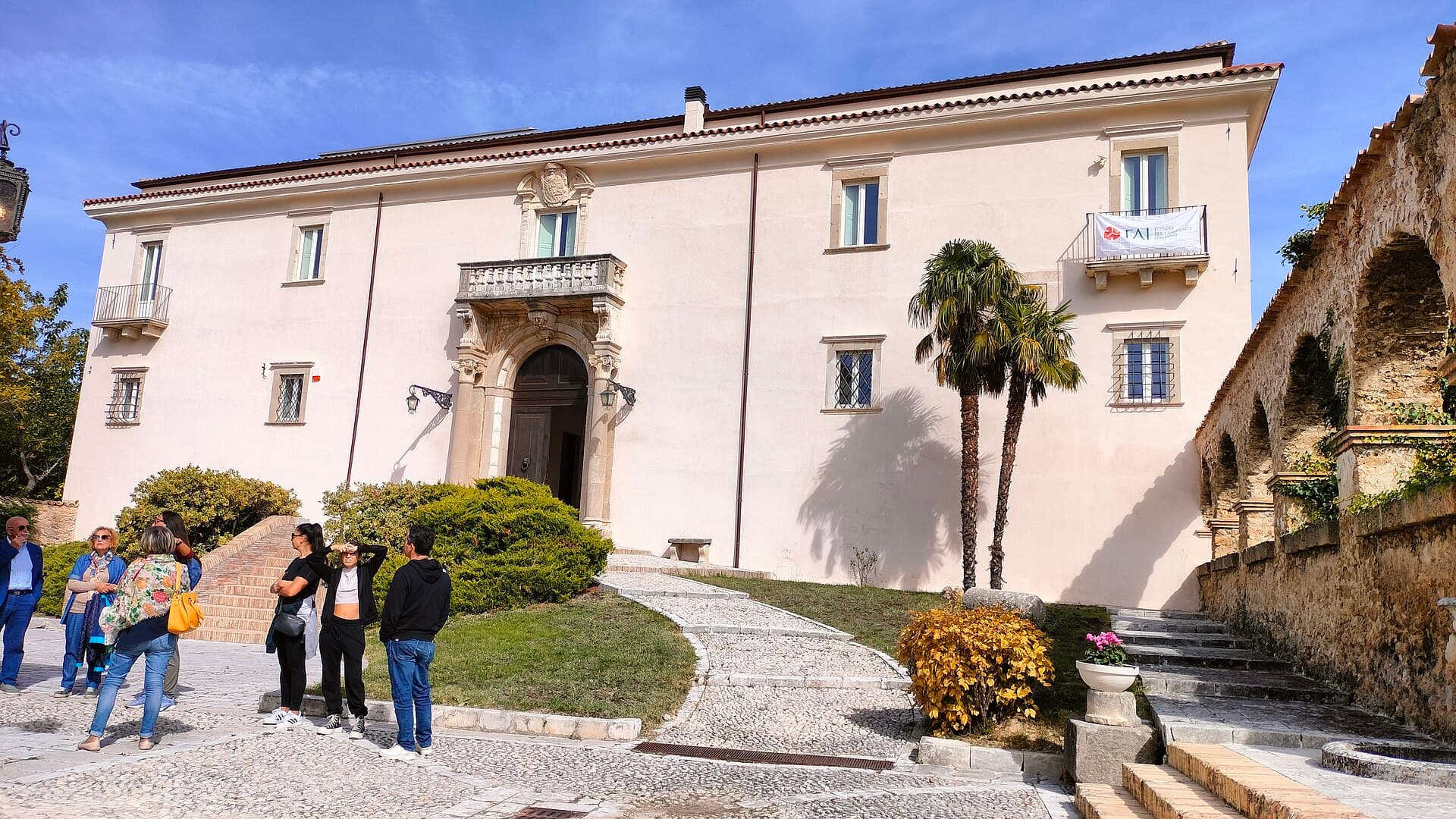
Castello Gizzi: Medieval Fortress Above Torre de’ Passeri
Step inside this 13th-century Abruzzo castle for sweeping valley views and a tangible link to the region's feudal past.
History of Castello Gizzi
Castello Gizzi stands on a rocky spur overlooking the Pescara River valley in Torre de’ Passeri. Built in the mid-13th century under the control of local feudal lords, the fortress later passed to the Gizzi family, who gave it its present name. Thick limestone walls, a square keep, and cylindrical towers remain largely intact, showing successive layers of defensive architecture rather than later decorative additions.
What to See and Do
Walk the ramparts for unobstructed views across the Maiella massif and the valley floor. Inside the courtyard, visitors can examine the original well and the vaulted rooms that once housed the garrison. A small exhibition space displays period tools and maps that illustrate how the castle controlled the narrow pass below. Photographers favor the late-afternoon light that rakes across the stone battlements and illuminates the surrounding olive groves.
Practical Exploration
- Allow at least ninety minutes to climb all accessible towers and walk the full circuit of walls.
- Bring binoculars to spot the distant peaks of the Gran Sasso and the outline of the old Via Valeria road.
- Combine the visit with a short walk down to the riverbank path for a different perspective of the castle silhouette.
Getting There
Torre de’ Passeri lies on the SS5 state road between Pescara and Sulmona. From the A25 motorway, exit at Torre de’ Passeri and follow signs uphill for roughly four kilometers. Limited parking is available at the base of the spur; the final approach is on foot via a paved but steep path. Regional trains stop at Torre de’ Passeri station, from which a local bus or taxi can reach the lower car park.
Best Time to Visit
Spring and autumn offer the clearest air and mild temperatures ideal for walking the walls. Summer brings longer daylight but stronger sun on the exposed stone; early morning visits avoid the heat. Winter visits are possible on clear days, when snow on the Maiella provides dramatic contrast, though the path may be icy after rain.
Nearby Attractions
Within a short drive are the Roman ruins at Corfinio, the medieval hill town of Popoli, and the entrance to the Maiella National Park. The nearby Abbey of San Clemente a Casauria, a 12th-century Benedictine complex, pairs naturally with a castle visit for those interested in Abruzzo’s layered history.
Visitor tips
- Wear sturdy shoes with good grip for the uneven stone surfaces and steep internal stairs.
- Visit early in the day or late afternoon to avoid midday glare on the ramparts and enjoy softer light for photography.
- Combine the castle with a stop at the nearby river park for a shaded picnic after climbing the towers.
Frequently asked questions
Is Castello Gizzi accessible for visitors with limited mobility?
Only the ground-level courtyard and a few rooms are flat; the towers and upper walls require climbing steep stairs and uneven surfaces.
Can you see inside the castle or is it only exterior viewing?
Several vaulted rooms and the exhibition space are open to the public, though the keep itself remains closed for structural reasons.
Are there guided tours available at Castello Gizzi?
Local volunteers occasionally lead free walks on weekends; otherwise the site is self-guided with basic signage.
What should I bring when visiting Castello Gizzi?
Water, sun protection, and comfortable walking shoes are essential; there are no facilities inside the walls.
Is Castello Gizzi suitable for children?
Older children who enjoy climbing will like the towers, but very young children need close supervision on the high walls and stairs.