
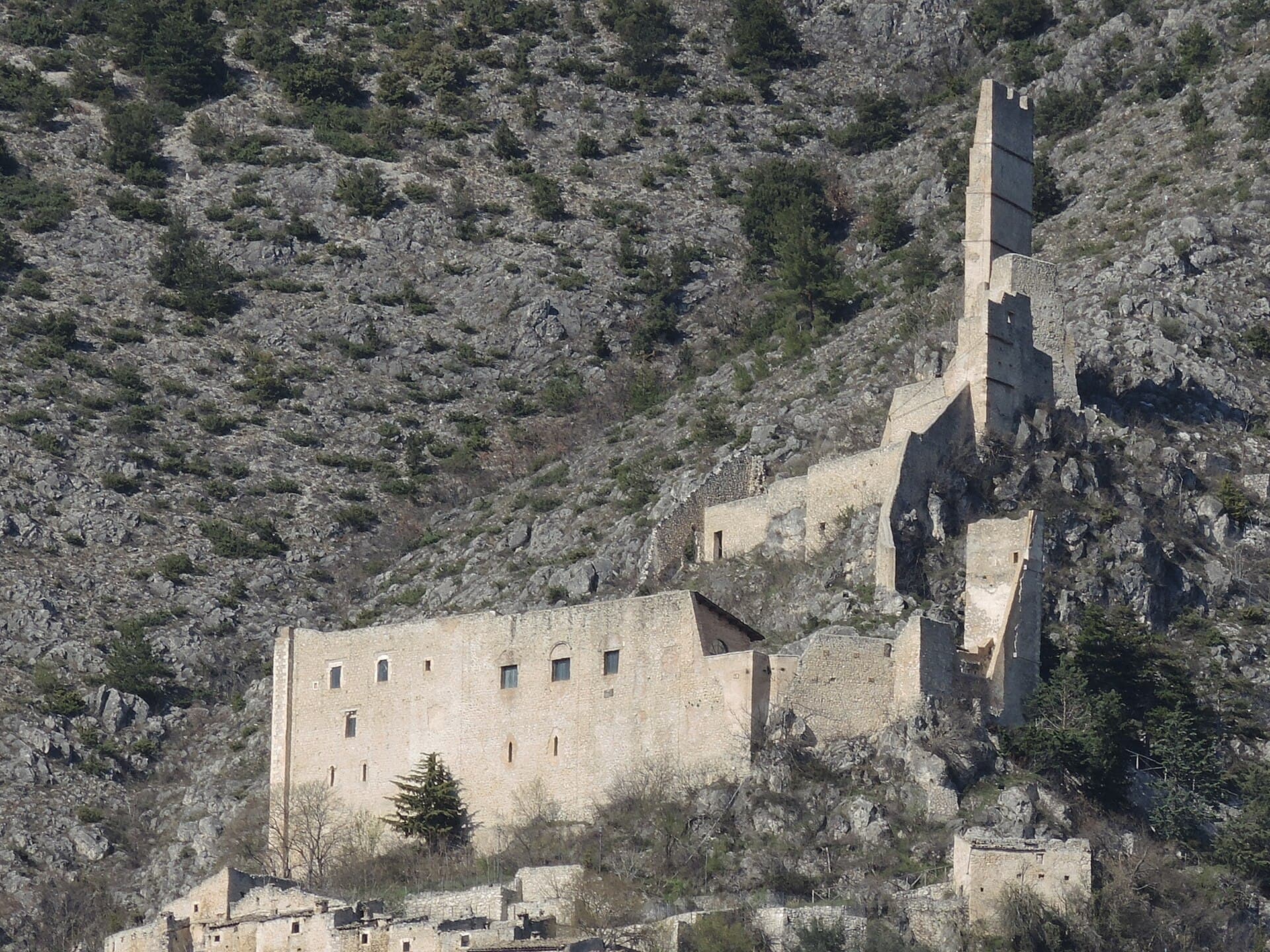
Castello di Roccacasale: Medieval Fortress Above Abruzzo’s Aterno Valley
A hilltop castle in Roccacasale offering sweeping mountain views, quiet ruins, and an authentic slice of Abruzzo’s medieval past.
Why Visit Castello di Roccacasale
Castello di Roccacasale stands on a rocky spur at the edge of the village of Roccacasale, commanding the narrow Aterno Valley and the western slopes of the Maiella massif. Its position made it a key defensive outpost from the 12th century onward, and the surviving walls and towers still give visitors a clear sense of that strategic role. Unlike larger, restored castles elsewhere in Italy, this fortress remains largely uncommercialized, letting travelers wander at their own pace amid lichen-covered stone and open sky.
What to See and Do
Begin at the lower village and follow the steep lane that climbs to the main gate. Inside the outer ward you can trace the original curtain wall, climb a short flight of steps to a surviving tower for valley views, and explore the small inner courtyard where a few vaulted rooms remain. Photographers favor the western ramparts at golden hour, when the Maiella peaks catch the last light. Below the castle, the village itself offers narrow lanes, a modest church, and a handful of family-run trattorias serving local lamb and saffron dishes.
Hiking and Nature
Marked trails leave directly from the castle gate and descend into the valley or ascend toward the Maiella foothills. Even a short 45-minute loop yields wild orchids in spring and sweeping views of the Gran Sasso in the distance. Carry water; there are no facilities on the paths.
How to Get There
The castle sits roughly 15 km east of Sulmona. Drivers can follow the SS5 highway to the Roccacasale exit, then the narrow but paved road up to the village parking area. From there the final approach is on foot. Public transport is limited; regional buses reach the village square a few times daily, after which the climb is about 20 minutes. Visitors coming from Rome or Pescara will find the drive through the valley scenic and straightforward.
Best Time to Visit
Late spring (May–June) and early autumn (September–October) bring comfortable temperatures and clear visibility for photography and walking. Summer days can be hot on the exposed stone, while winter snow occasionally blocks the upper road. Weekdays are quieter than weekends, when local families sometimes picnic near the walls.
Nearby Attractions
Combine a castle visit with the compact historic center of Sulmona, famous for its confetti almonds and medieval aqueduct. The Parco Nazionale della Maiella offers further hiking and the dramatic Hermitage of San Giovanni in the valley below. A short drive north brings you to the hill town of Pacentro and its own restored castle, creating an easy half-day circuit of Abruzzo’s medieval heritage.
Visitor tips
- Wear sturdy shoes with good grip; the stone steps and paths inside the castle are uneven and can be slippery after rain.
- Bring water and a light jacket even in summer, as there is no shade or services once you pass the village square.
- Visit early in the day or on weekdays to avoid small tour groups and to enjoy the best light for photography from the ramparts.
Frequently asked questions
Is Castello di Roccacasale suitable for children?
Yes, older children who enjoy walking on uneven ground will find the site engaging, though there are no play areas or guided activities.
Can you drive all the way to the castle?
You can drive to a small parking area at the edge of the village; the final stretch to the castle itself is a short uphill walk on a paved lane.
Are there restrooms or cafu00e9s at the castle?
No facilities exist inside the castle walls. The nearest restrooms and simple cafu00e9s are in the village square a few minutesu2019 walk downhill.
How long should I plan to spend at Castello di Roccacasale?
Most visitors spend 45u201390 minutes exploring the walls and towers; add another hour if you intend to hike one of the short trails that start nearby.
Is the site accessible for visitors with limited mobility?
The steep approach lane and uneven stone surfaces make the castle unsuitable for wheelchairs or visitors who cannot manage slopes and steps.