
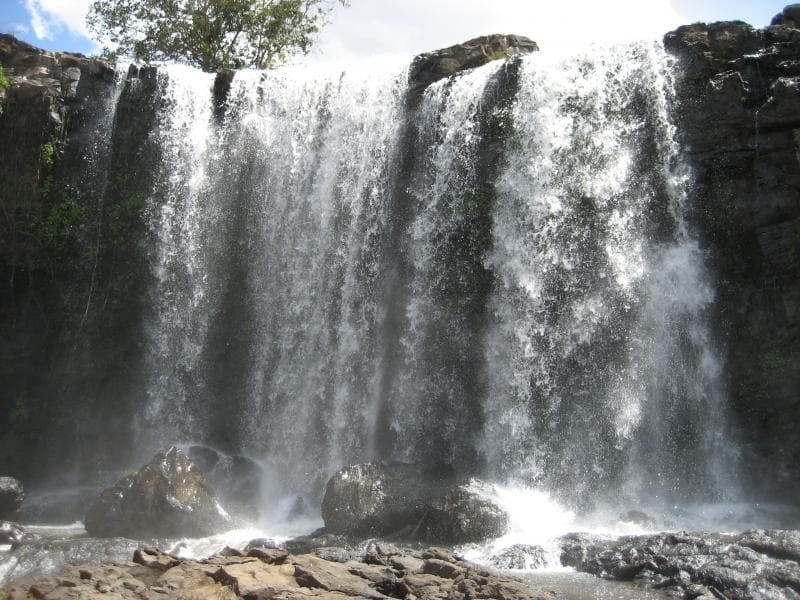
Bou Sra Waterfall: Cambodia’s Three-Tiered Jungle Cascade in Mondulkiri
A powerful, multi-level waterfall set deep in Mondulkiri’s evergreen forest, Bou Sra offers swimming holes, forest walks, and a rare sense of scale.
Why Bou Sra Waterfall Stands Out
Bou Sra drops in three distinct tiers through dense jungle in Pechr Chenda District. The first tier creates a wide, deep pool ringed by smooth rock slabs where visitors swim year-round. The second and third tiers require a short climb or walk along the river and reveal narrower, more dramatic drops that few tourists reach. The surrounding forest belongs to the Bunong indigenous community, whose villages lie just outside the site.
Getting There
Most travelers base themselves in Sen Monorom, the provincial capital of Mondulkiri, then continue by motorbike, taxi, or arranged tour along the red-earth road that leads east. The route passes rolling hills, rubber plantations, and small Bunong settlements before entering thicker forest. The final stretch is a well-maintained dirt track suitable for ordinary cars in the dry months; after heavy rain, a sturdy motorbike or four-wheel-drive vehicle is preferable.
Best Time to Visit
November through February brings cooler temperatures and clearer roads, making the forest walk comfortable. March to May sees lower water levels but fewer visitors and easier access to the upper tiers. June to October produces the strongest flow and mist, yet the access road can become slippery and the river crossing hazardous; check local conditions before setting out.
What to See and Do
Spend the first hour at the large pool below the first drop, where the water remains deep enough for swimming even in drier months. A short, marked path climbs beside the falls to a viewpoint overlooking the second tier; sturdy footwear is essential on the damp rocks. Adventurous visitors can continue upstream to the third tier, following the riverbed for roughly thirty minutes. Local guides also lead half-day walks that combine the waterfall with nearby Bunong villages and resin-tapping trails.
Practical Considerations
- Bring reef-safe sunscreen and insect repellent; the forest canopy does not block all sun or mosquitoes.
- Pack water and a simple lunch; vendors near the parking area sell drinks and grilled corn, but options are limited once you start walking.
- Respect the site: do not leave trash, and avoid climbing on wet rocks above the main pool where footing is treacherous.
Nearby Attractions
After visiting Bou Sra, many travelers continue to the smaller but equally scenic Dak Dam Waterfall or explore the Mondulkiri highlands on a loop that includes the Snuol rubber plantation and the remote wildlife sanctuary of Phnom Prich. The provincial capital Sen Monorom itself offers hill views, fresh coffee, and the chance to arrange elephant-sanctuary visits that support ethical care of retired working elephants.
Visitor tips
- Wear shoes with good grip; the paths and rocks around the upper tiers become slippery after rain.
- Carry cash in small denominations; mobile signal is weak and card payments are unavailable at the site.
- Start early in the day to avoid afternoon crowds and to have the best light for photographs of the first tier.
Frequently asked questions
How far is Bou Sra Waterfall from Sen Monorom?
The drive or ride takes roughly one to one-and-a-half hours along a mostly paved then dirt road, depending on weather and vehicle.
Can I swim at Bou Sra Waterfall?
Yes, the large natural pool at the base of the first tier is popular for swimming; the water is coolest in the morning.
Is it possible to reach the second and third tiers without a guide?
The second tier is reachable by a clear but steep path; the third tier requires following the riverbed and is best attempted with someone familiar with the route.
Are there facilities such as toilets or food at the waterfall?
Basic toilets and simple food stalls operate near the parking area; nothing is available once you walk deeper into the forest.
What should I wear and bring for a visit?
Light, quick-dry clothing, sturdy shoes, swimwear, insect repellent, and drinking water are the essentials; a hat and rain jacket are useful in any season.