
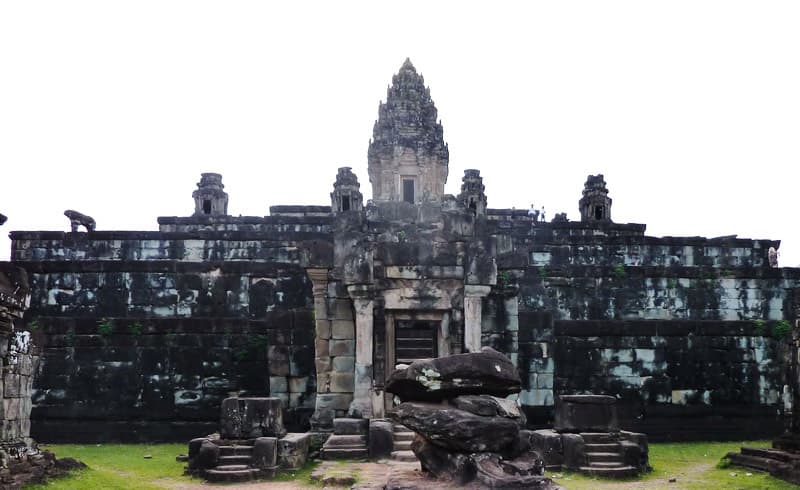
Bakong: Cambodia’s First Temple Mountain in the Roluos Group
Visit the 9th-century Bakong, the earliest Angkor-era temple-mountain, for a quieter glimpse into the origins of Khmer architecture.
History and Significance
Bakong stands as the earliest surviving temple-mountain built by the Khmer kings, constructed in 881 by Indravarman I. Dedicated to Shiva, it introduced the stepped-pyramid design that later defined Angkor Wat and other major monuments. Located in the Roluos archaeological zone 13 kilometers east of Siem Reap, the temple marks the shift of the capital from earlier sites to the Angkor plain and demonstrates the first large-scale use of durable stone and brick in Khmer religious architecture.
What to See and Do
The central sanctuary rises in five tiers, crowned by a later 12th-century tower that replaced the original. Five brick towers line the eastern side of the first level, each carved with intricate lintels showing deities and mythical scenes. A broad laterite causeway flanked by naga balustrades leads visitors across a dry moat to the main structure. At ground level, sandstone elephants guard the corners of each terrace, while smaller shrines and boundary stones mark the original enclosure. Walking the perimeter reveals carved sandstone blocks and remnants of the original brick towers that still display traces of stucco decoration.
Exploring the Site
Allow at least 45 minutes to climb the central pyramid and examine the carvings up close. The upper terraces offer views across the surrounding rice fields and the distant outline of other Roluos monuments. Because the site receives far fewer visitors than the main Angkor temples, the atmosphere remains peaceful, making it ideal for photography and quiet reflection.
Getting There and Practical Information
Bakong lies along the main road between Siem Reap and the Roluos group. Most travelers reach it by tuk-tuk, private car, or bicycle from Siem Reap in roughly 25 minutes. Entry is included with the standard Angkor Archaeological Park ticket, so visitors can combine Bakong with Preah Ko and Lolei in a single half-day circuit. Paths are largely level but include uneven laterite and stone steps; comfortable walking shoes are recommended.
Best Time to Visit
The dry season from November to April provides the most comfortable conditions, with clear skies and firm ground. Early morning visits avoid the midday heat and allow soft light on the carvings. The rainy season brings lush greenery but occasional muddy paths and fewer services.
Nearby Attractions
Just two kilometers west stands Preah Ko, featuring six brick towers on a single platform. A short distance farther lies Lolei, built on an artificial island in the middle of the Indratataka baray. These three sites together illustrate the rapid evolution of Khmer temple design within a single generation. Beyond Roluos, the main Angkor complex and the floating village of Kompong Phluk lie within an easy day’s travel.