
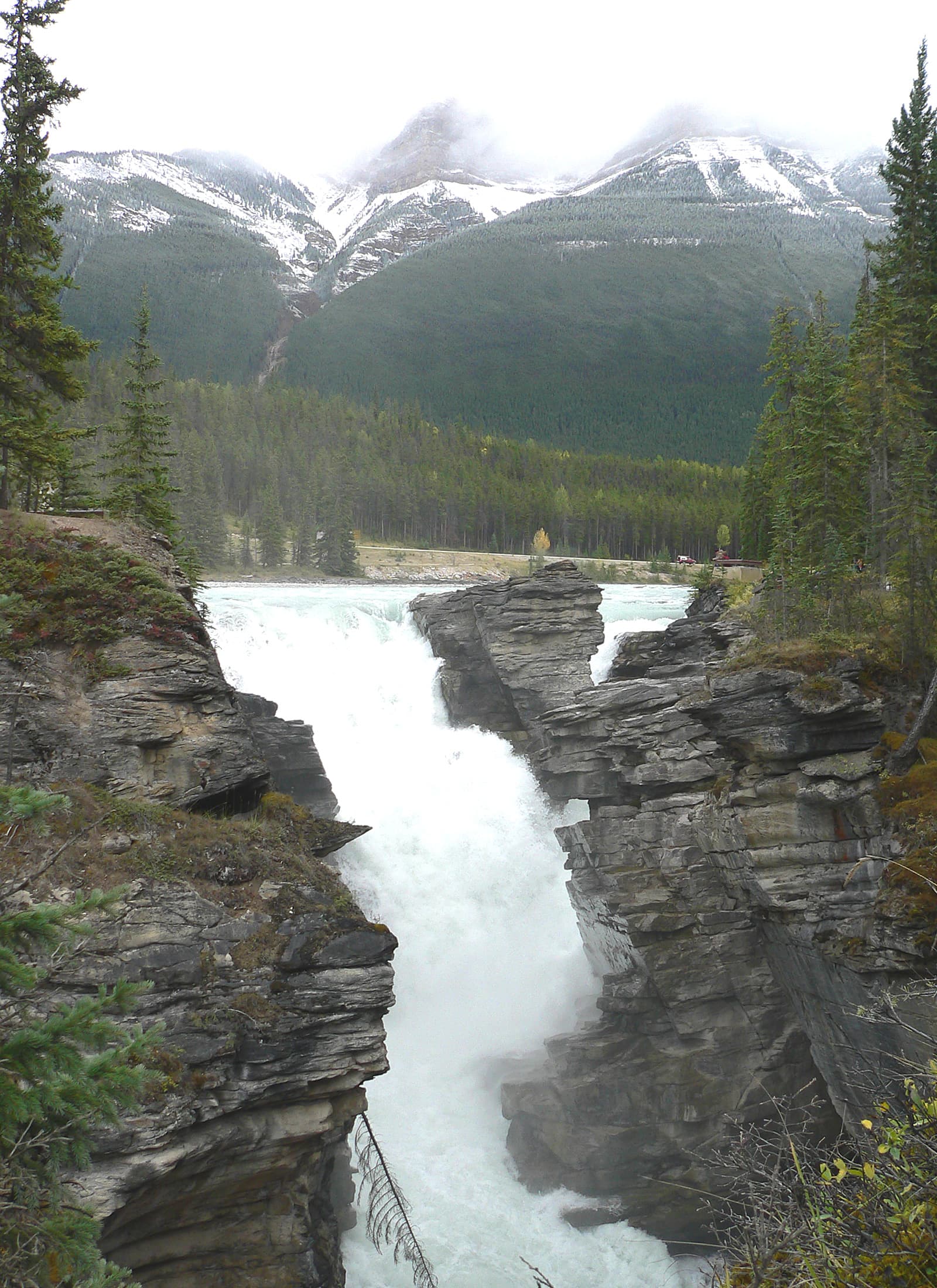
Athabasca Falls: A Must-See Waterfall in Jasper National Park
Experience the raw power of Athabasca Falls, one of the most dramatic cascades in the Canadian Rockies.
Why Athabasca Falls Stands Out
Athabasca Falls cuts through resistant quartzite rock on the Athabasca River, creating a thunderous display even when water levels drop. The falls drop roughly 23 metres into a narrow gorge, sending mist high into the air and carving potholes and sculpted walls that reveal the river’s force over thousands of years. Unlike many alpine waterfalls that rely on seasonal snowmelt, Athabasca Falls maintains strong flow year-round because it draws from the Columbia Icefield and numerous upstream glaciers.
How to Reach Athabasca Falls
The site lies along the Icefields Parkway (Highway 93), roughly 28 kilometres south of Jasper townsite. Drivers heading from the south pass the Columbia Icefield Discovery Centre first; those coming from Jasper follow the parkway’s gentle curves past Mount Kerkeslin. A large, clearly signed parking area sits directly beside the falls, with short, paved paths leading to multiple viewing platforms. No long hikes are required, making the falls accessible for most visitors, including families and those with limited mobility.
Best Time to Visit
Peak water volume occurs from June through early August when glacial melt is highest, producing the loudest roar and densest mist. Late September brings fewer crowds and golden larch colour on surrounding slopes. Winter transforms the gorge into an ice sculpture; the falls remain impressive but require caution on icy walkways. Shoulder months of May and October offer a balance of decent flow and quieter trails.
What to See and Do at the Falls
Begin at the upper viewpoint where the full width of the river plunges over the lip. Follow the short boardwalk downstream to platforms overlooking the narrow canyon and the famous pothole formed by swirling boulders. Early morning or late afternoon light often creates rainbows in the spray. Photographers should bring lens cloths for constant mist and consider a tripod for longer exposures that turn the water into silk. A short trail also leads across a footbridge to the far side of the gorge for different angles.
Nearby Attractions Worth Adding
Continue south on the Icefields Parkway to reach the Columbia Icefield and its glacier-fed lakes. Northbound travellers can stop at Sunwapta Falls, another roadside cascade with a longer loop trail. For a full day, combine Athabasca Falls with a drive to Maligne Lake or a short hike at Mount Edith Cavell. The entire Icefields Parkway is a UNESCO World Heritage corridor, so scenic pullouts abound in both directions.
Practical Considerations
Park admission is required for Jasper National Park. Cell service is limited along the parkway, so download offline maps beforehand. Restrooms and interpretive signs are available at the site, but no food or fuel is sold directly at the falls. Pack layers; temperatures can drop quickly near the cold, fast-moving water.
Visitor tips
- Arrive before 10 a.m. or after 4 p.m. in summer to secure parking and enjoy fewer people at the viewpoints.
- Wear shoes with good grip; the paths and platforms can be wet and slippery from constant spray.
- Bring a rain jacket or poncho even on sunny daysu2014the mist from the falls travels far beyond the railings.
Frequently asked questions
How long does it take to visit Athabasca Falls?
Most visitors spend 30 to 60 minutes walking the short paths and viewing platforms; allow extra time for photography or picnics.
Is Athabasca Falls accessible for wheelchairs or strollers?
The main upper viewpoint and several lower platforms are reached by paved, relatively flat paths suitable for wheelchairs and strollers, though some side trails include stairs.
Can you swim or get close to the water at Athabasca Falls?
Swimming is extremely dangerous and prohibited due to strong currents and cold glacial water; stay on designated paths and behind safety railings.
What should I wear when visiting in winter?
Wear ice cleats or traction devices on boots, dress in warm layers, and expect some viewpoints to be closed or restricted when ice builds up.
Are there hiking trails beyond the immediate falls area?
The main attraction is the short, accessible loop, but longer trails such as the Geraldine Lakes route begin nearby for those seeking more distance.